Vector Autoregressions

From Reduced Form to Structural Identification

The VAR Framework

Vector Autoregressions (VARs) model the joint dynamics of multiple time series. VARs became the workhorse of empirical macroeconomics because they impose minimal theoretical structure while capturing rich dynamic interactions. For a comprehensive treatment, see Kilian and Lütkepohl (2017).

From Single Equations to Systems

Consider a simple monetary policy question: How does output respond to an interest rate change?

Single equation approach: \[ y_t = \alpha + \beta \cdot r_t + \varepsilon_t \]

Problems: - Interest rates respond to output (simultaneity) - Past values of both matter (dynamics) - Other variables are omitted

VAR approach: Model everything jointly: \[ \begin{bmatrix} y_t \\ \pi_t \\ r_t \end{bmatrix} = \mathbf{c} + \mathbf{A}_1 \begin{bmatrix} y_{t-1} \\ \pi_{t-1} \\ r_{t-1} \end{bmatrix} + \mathbf{A}_2 \begin{bmatrix} y_{t-2} \\ \pi_{t-2} \\ r_{t-2} \end{bmatrix} + \begin{bmatrix} u_{1t} \\ u_{2t} \\ u_{3t} \end{bmatrix} \]

Reduced-Form VAR

The Model

A VAR(p) for K variables: \[ \mathbf{y}_t = \mathbf{c} + \mathbf{A}_1 \mathbf{y}_{t-1} + \mathbf{A}_2 \mathbf{y}_{t-2} + \cdots + \mathbf{A}_p \mathbf{y}_{t-p} + \mathbf{u}_t \]

where: - \(\mathbf{y}_t\) is \(K \times 1\) vector of endogenous variables - \(\mathbf{A}_j\) are \(K \times K\) coefficient matrices - \(\mathbf{u}_t \sim N(\mathbf{0}, \boldsymbol{\Sigma}_u)\) are reduced-form residuals - \(\boldsymbol{\Sigma}_u\) captures contemporaneous correlations

Key property: Reduced-form residuals \(\mathbf{u}_t\) are correlated across equations. They are not structural shocks.

Estimation

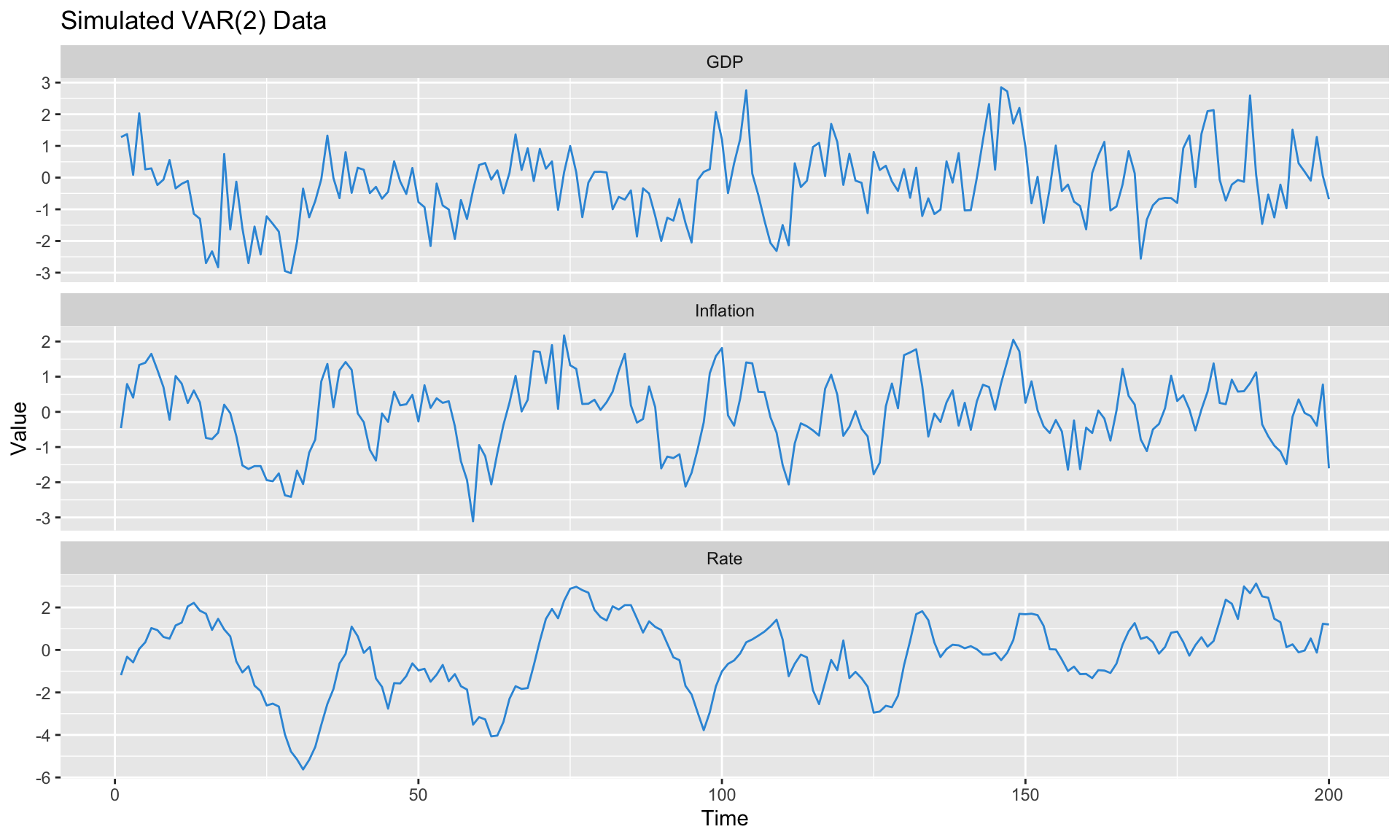
Each equation can be estimated by OLS (since all equations have the same regressors). Let’s simulate and estimate.

Code
# Simulate a simple 3-variable VAR(2)
simulate_var <- function(T_obs, A1, A2, Sigma, burn = 100) {
  K <- nrow(A1)
  Y <- matrix(0, T_obs + burn, K)

  # Generate shocks
  U <- mvrnorm(T_obs + burn, mu = rep(0, K), Sigma = Sigma)

  for (t in 3:(T_obs + burn)) {
    Y[t, ] <- A1 %*% Y[t-1, ] + A2 %*% Y[t-2, ] + U[t, ]
  }

  Y[(burn + 1):(T_obs + burn), ]
}

# True parameters
A1_true <- matrix(c(
  0.5,  0.1,  0.0,   # GDP equation
  0.2,  0.6, -0.1,   # Inflation equation
  0.1,  0.3,  0.7    # Interest rate equation
), nrow = 3, byrow = TRUE)

A2_true <- matrix(c(
  0.2, -0.1,  0.0,
  0.0,  0.1,  0.05,
  0.0,  0.1,  0.1
), nrow = 3, byrow = TRUE)

# Reduced-form covariance (correlated shocks)
Sigma_true <- matrix(c(
  1.0, 0.3, 0.1,
  0.3, 0.5, 0.2,
  0.1, 0.2, 0.3
), nrow = 3)

# Simulate
Y <- simulate_var(200, A1_true, A2_true, Sigma_true)
colnames(Y) <- c("GDP", "Inflation", "Rate")

# Plot
data.frame(
  time = 1:nrow(Y),
  as.data.frame(Y)
) %>%
  pivot_longer(-time, names_to = "variable", values_to = "value") %>%
  ggplot(aes(x = time, y = value)) +
  geom_line(color = "#3498db") +
  facet_wrap(~variable, scales = "free_y", ncol = 1) +
  labs(title = "Simulated VAR(2) Data",
       x = "Time", y = "Value")

Simulated three-variable VAR system
Code
# Estimate VAR using vars package
Y_ts <- ts(Y, frequency = 4)

# Select lag length
lag_select <- VARselect(Y_ts, lag.max = 8, type = "const")
cat("Lag selection criteria:\n")
Lag selection criteria:
Code
print(lag_select$selection)
AIC(n)  HQ(n)  SC(n) FPE(n) 
     2      1      1      2 
Code
# Estimate VAR(2)
var_model <- VAR(Y_ts, p = 2, type = "const")

# Check stability
cat("\nEigenvalues of companion matrix (all should be < 1):\n")

Eigenvalues of companion matrix (all should be < 1):
Code
print(round(roots(var_model), 3))
[1] 0.838 0.838 0.639 0.371 0.123 0.123

Companion Form and Stability

For analysis, we write the VAR in companion form: \[ \mathbf{Y}_t = \mathbf{A}_{comp} \mathbf{Y}_{t-1} + \mathbf{U}_t \]

where \(\mathbf{Y}_t = [\mathbf{y}_t', \mathbf{y}_{t-1}', \ldots]'\) stacks lagged values.

Stability condition: All eigenvalues of \(\mathbf{A}_{comp}\) must lie inside the unit circle. If any eigenvalue equals 1, there’s a unit root; if greater than 1, the system is explosive.

The Identification Problem

Why Structure Matters

The reduced-form VAR gives us \(\boldsymbol{\Sigma}_u\)—the covariance of residuals. But we want structural shocks \(\boldsymbol{\varepsilon}_t\) that are: - Uncorrelated with each other - Have economic interpretation (demand shock, supply shock, monetary shock)

The structural form: \[ \mathbf{B}_0 \mathbf{y}_t = \mathbf{b}_0 + \mathbf{B}_1 \mathbf{y}_{t-1} + \cdots + \boldsymbol{\varepsilon}_t, \quad \boldsymbol{\varepsilon}_t \sim N(\mathbf{0}, \mathbf{I}) \]

Connection to reduced form: \[ \mathbf{u}_t = \mathbf{B}_0^{-1} \boldsymbol{\varepsilon}_t \implies \boldsymbol{\Sigma}_u = \mathbf{B}_0^{-1} (\mathbf{B}_0^{-1})' \]

The Counting Problem

With K variables: - \(\boldsymbol{\Sigma}_u\) has \(K(K+1)/2\) unique elements - \(\mathbf{B}_0^{-1}\) has \(K^2\) elements - We need \(K(K-1)/2\) additional restrictions

For K=3: We observe 6 unique elements of \(\Sigma_u\), but need 9 elements of \(B_0^{-1}\). We need 3 restrictions.

ImportantThe Fundamental Challenge

Moving from reduced-form to structural requires identifying assumptions. Different assumptions = different structural shocks = potentially different conclusions.

Recursive (Cholesky) Identification

The Approach

The simplest identification: assume a recursive causal ordering.

\[ \mathbf{B}_0^{-1} = \text{chol}(\boldsymbol{\Sigma}_u) \quad \text{(lower triangular)} \]

This imposes: - Variable 1 doesn’t respond contemporaneously to variables 2 or 3 - Variable 2 doesn’t respond contemporaneously to variable 3 - Variable 3 responds to everything

Economic Interpretation

For monetary policy, a common ordering: slow → policy → fast

  1. GDP (slow): doesn’t respond within quarter to anything
  2. Inflation (medium): responds to GDP shocks, not rate within quarter
  3. Interest rate (fast): central bank sees GDP and inflation, then sets rate
Code
# Compute Cholesky-identified IRFs
irf_chol <- irf(var_model, impulse = "Rate", response = c("GDP", "Inflation", "Rate"),
                n.ahead = 20, ortho = TRUE, boot = TRUE, ci = 0.68, runs = 100)

# Extract and plot
plot_irf <- function(irf_obj, shock_name) {
  responses <- names(irf_obj$irf)

  irf_data <- lapply(responses, function(resp) {
    data.frame(
      horizon = 0:(length(irf_obj$irf[[resp]][, 1]) - 1),
      response = resp,
      estimate = irf_obj$irf[[resp]][, 1],
      lower = irf_obj$Lower[[resp]][, 1],
      upper = irf_obj$Upper[[resp]][, 1]
    )
  }) %>% bind_rows()

  ggplot(irf_data, aes(x = horizon, y = estimate)) +
    geom_hline(yintercept = 0, linetype = "dashed", alpha = 0.5) +
    geom_ribbon(aes(ymin = lower, ymax = upper), alpha = 0.2, fill = "#e74c3c") +
    geom_line(color = "#e74c3c", size = 1) +
    facet_wrap(~response, scales = "free_y") +
    labs(title = paste("Response to", shock_name, "Shock"),
         subtitle = "68% bootstrap confidence bands",
         x = "Horizon (quarters)", y = "Response")
}

plot_irf(irf_chol, "Monetary Policy (Rate)")

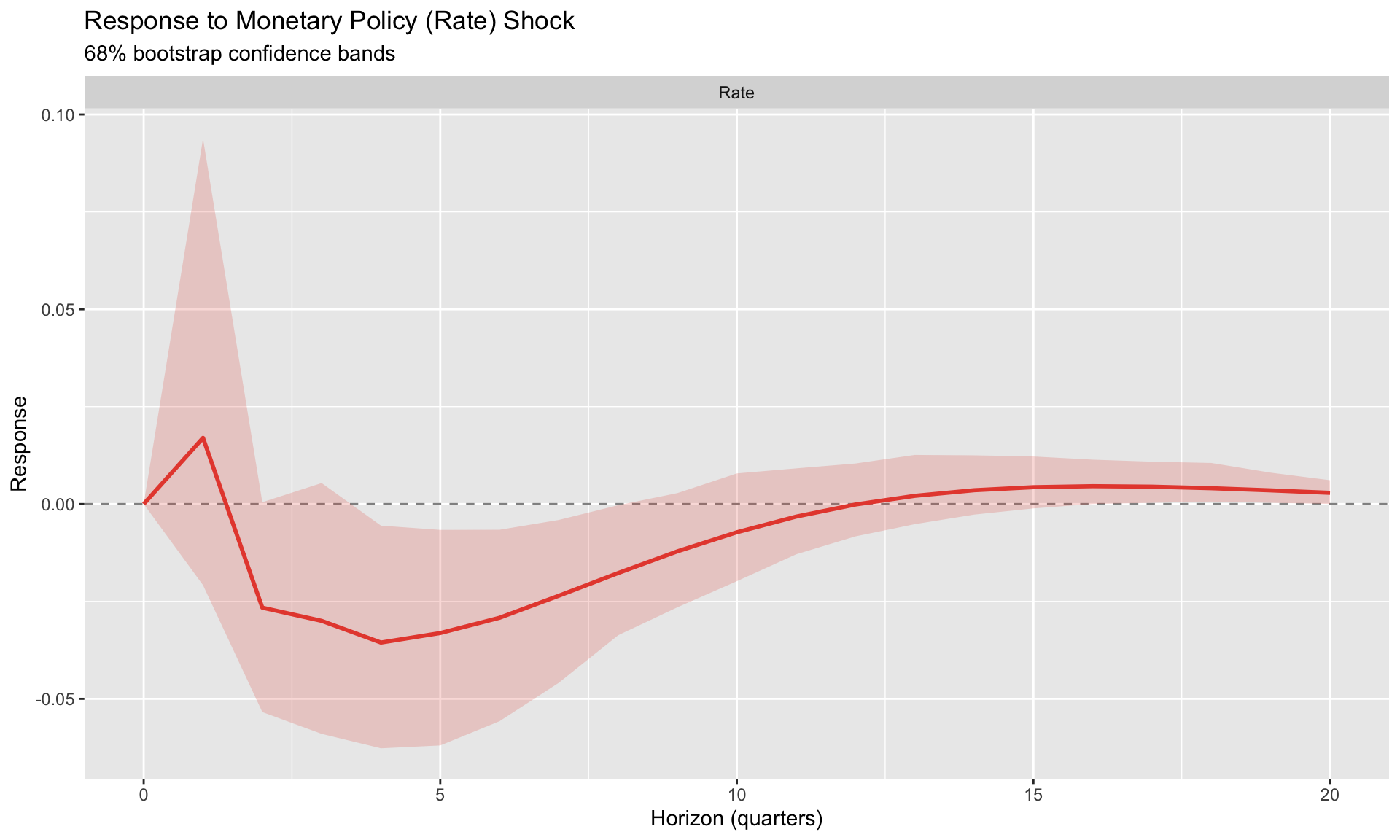
Impulse responses to monetary policy shock (Cholesky identification)

The Ordering Problem

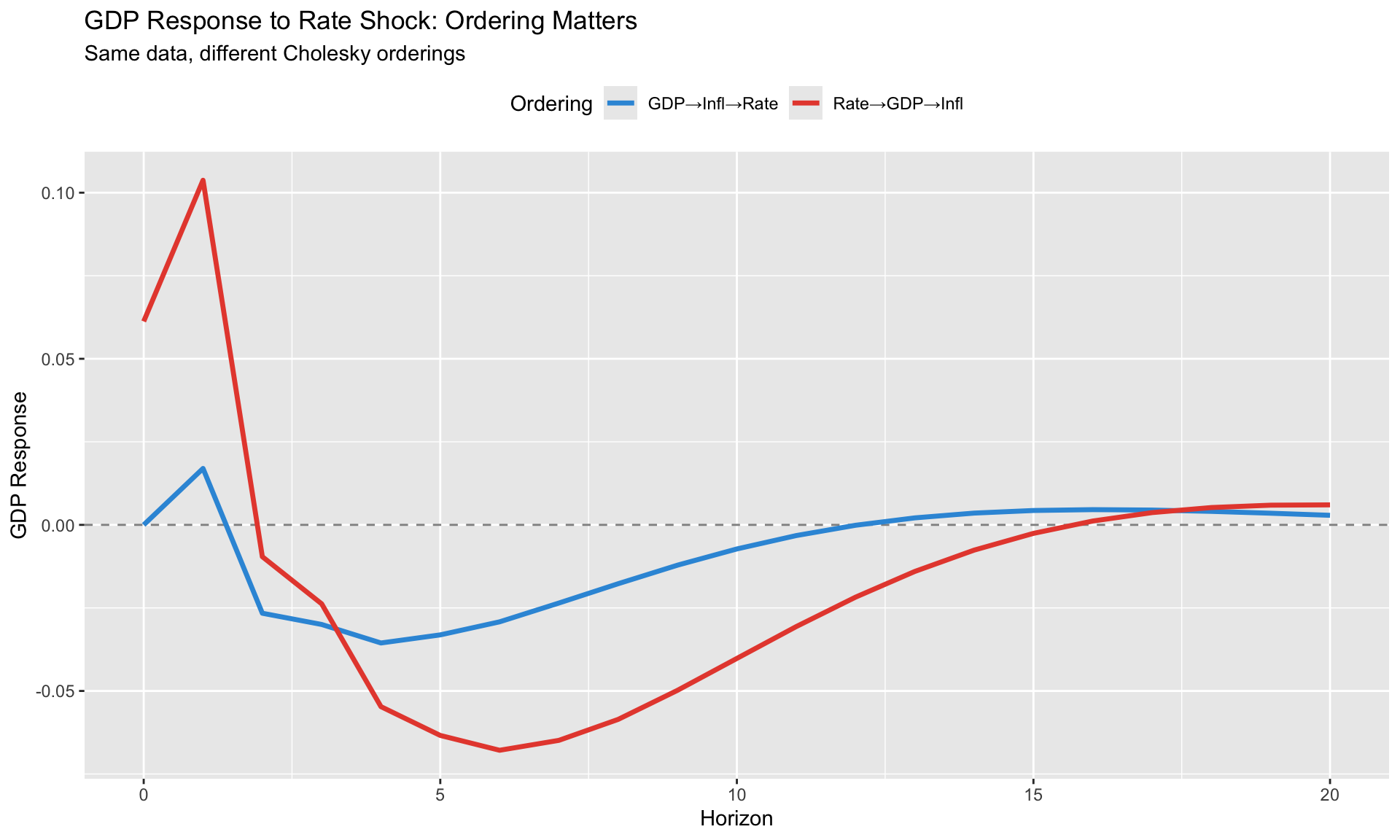
Cholesky identification is sensitive to ordering. Let’s see what happens with a different order:
Code
# Original ordering: GDP, Inflation, Rate
Y_order1 <- Y_ts[, c("GDP", "Inflation", "Rate")]
var_order1 <- VAR(Y_order1, p = 2, type = "const")
irf_order1 <- irf(var_order1, impulse = "Rate", response = "GDP",
                   n.ahead = 20, ortho = TRUE, boot = FALSE)

# Alternative ordering: Rate, GDP, Inflation (rate first)
Y_order2 <- Y_ts[, c("Rate", "GDP", "Inflation")]
var_order2 <- VAR(Y_order2, p = 2, type = "const")
irf_order2 <- irf(var_order2, impulse = "Rate", response = "GDP",
                   n.ahead = 20, ortho = TRUE, boot = FALSE)

# Compare
compare_df <- data.frame(
  horizon = 0:20,
  Order1 = irf_order1$irf$Rate[, "GDP"],
  Order2 = irf_order2$irf$Rate[, "GDP"]
) %>%
  pivot_longer(-horizon, names_to = "ordering", values_to = "response")

ggplot(compare_df, aes(x = horizon, y = response, color = ordering)) +
  geom_hline(yintercept = 0, linetype = "dashed", alpha = 0.5) +
  geom_line(size = 1.2) +
  scale_color_manual(values = c("Order1" = "#3498db", "Order2" = "#e74c3c"),
                     labels = c("GDP→Infl→Rate", "Rate→GDP→Infl")) +
  labs(title = "GDP Response to Rate Shock: Ordering Matters",
       subtitle = "Same data, different Cholesky orderings",
       x = "Horizon", y = "GDP Response",
       color = "Ordering") +
  theme(legend.position = "top")

IRF sensitivity to variable ordering
WarningAlways Check Robustness

If your conclusions change substantially with ordering, your identification is fragile. Report results under alternative orderings.

Sign Restrictions

The Idea

Instead of exact zero restrictions, impose inequality constraints based on economic theory.

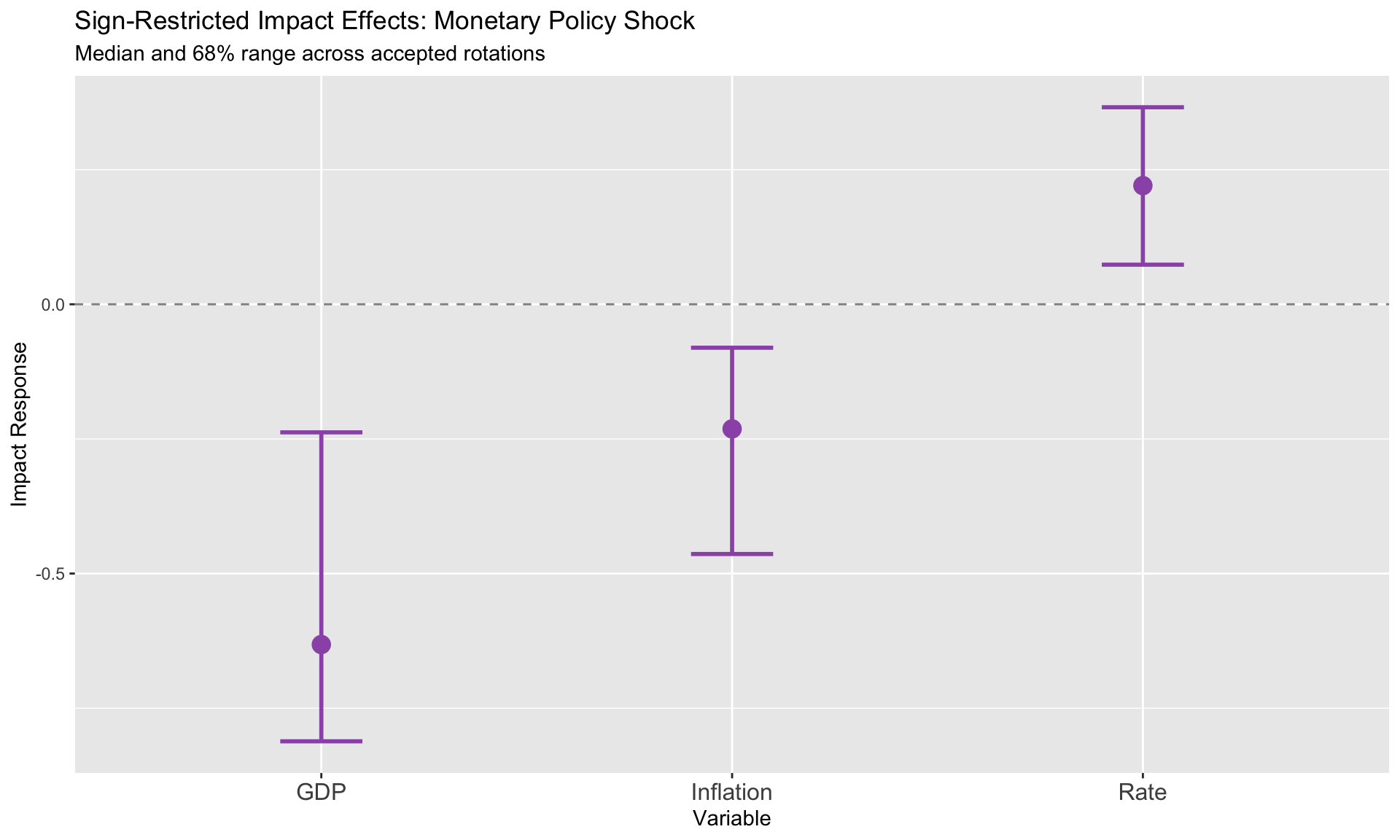
For a monetary policy tightening: - Interest rate rises (+) - Output falls (−) - Inflation falls (−)

This doesn’t uniquely identify the shock—it defines a set of admissible structural models.

Algorithm

  1. Compute any valid \(\mathbf{B}_0^{-1}\) (e.g., Cholesky)
  2. Draw a random orthogonal matrix \(\mathbf{Q}\)
  3. Candidate: \(\tilde{\mathbf{B}} = \mathbf{B}_0^{-1} \mathbf{Q}\)
  4. Compute IRFs with \(\tilde{\mathbf{B}}\)
  5. Check if signs match restrictions
  6. If yes: accept. If no: reject and return to step 2.
Code
# Simplified sign restriction illustration
# (Full implementation available in svars package)

# For a 3-variable system with monetary policy shock restrictions:
# - GDP falls (-)
# - Inflation falls (-)
# - Rate rises (+)

# Illustrate the concept with Cholesky baseline and perturbations
K <- 3
Sigma_est <- summary(var_model)$covres
B0_inv <- t(chol(Sigma_est))

# Draw multiple rotations and keep those satisfying sign restrictions
set.seed(42)
n_draw <- 50
accepted <- list()
n_accepted <- 0

for (i in 1:500) {
  # Random orthogonal matrix
  X <- matrix(rnorm(K * K), K, K)
  Q <- qr.Q(qr(X))

  # Candidate impact
  B_cand <- B0_inv %*% Q

  # Check signs for monetary shock (column 3): GDP(-), Infl(-), Rate(+)
  if (B_cand[1, 3] < 0 && B_cand[2, 3] < 0 && B_cand[3, 3] > 0) {
    n_accepted <- n_accepted + 1
    accepted[[n_accepted]] <- B_cand[, 3]  # Just save impact vector
    if (n_accepted >= n_draw) break
  }
}

cat("Acceptance rate:", round(n_accepted / min(i, 500) * 100, 1), "%\n")
Acceptance rate: 24.3 %
Code
cat("Accepted draws:", n_accepted, "\n")
Accepted draws: 50 
Code
# Show range of impact effects
impact_matrix <- do.call(rbind, accepted)
colnames(impact_matrix) <- c("GDP", "Inflation", "Rate")

impact_summary <- data.frame(
  variable = c("GDP", "Inflation", "Rate"),
  median = apply(impact_matrix, 2, median),
  lower = apply(impact_matrix, 2, quantile, 0.16),
  upper = apply(impact_matrix, 2, quantile, 0.84)
)

ggplot(impact_summary, aes(x = variable, y = median)) +
  geom_hline(yintercept = 0, linetype = "dashed", alpha = 0.5) +
  geom_errorbar(aes(ymin = lower, ymax = upper), width = 0.2, color = "#9b59b6", size = 1) +
  geom_point(color = "#9b59b6", size = 4) +
  labs(title = "Sign-Restricted Impact Effects: Monetary Policy Shock",
       subtitle = "Median and 68% range across accepted rotations",
       x = "Variable", y = "Impact Response") +
  theme(axis.text.x = element_text(size = 12))

Sign-restricted IRFs show a range of admissible models
NoteFull Implementation

For complete sign-restricted IRFs across all horizons, use the svars package:

library(svars)
id.sign(var_model, restriction_matrix = sign_matrix)

Set Identification vs. Point Identification

Aspect Point Identification (Cholesky) Set Identification (Signs)
Result Single IRF Range of IRFs
Assumptions Exact zeros Inequality constraints
Robustness Sensitive to ordering Theory-guided
Interpretation “The” effect Bounds on effect

External Instruments (Proxy SVAR)

The Approach

Use an external instrument \(z_t\) correlated with one structural shock but not others.

Requirements: - Relevance: \(E[z_t \varepsilon_{1t}] \neq 0\) - Exogeneity: \(E[z_t \varepsilon_{jt}] = 0\) for \(j \neq 1\)

Common instruments for monetary policy: - High-frequency surprises around FOMC announcements - Narrative identification (Romer & Romer)

Implementation

Code
# Simulate an external instrument
# True: z is correlated with the monetary shock only
set.seed(123)
T_obs <- nrow(Y)

# Generate structural shocks (we'll pretend we don't observe these)
# For simulation, we know the true Cholesky gives us structural shocks
Sigma_est <- cov(residuals(var_model))
B0_inv_true <- t(chol(Sigma_est))
u_hat <- residuals(var_model)
eps_hat <- solve(B0_inv_true) %*% t(u_hat)  # "structural" shocks

# External instrument: correlated with monetary shock (row 3) + noise
phi <- 0.6  # relevance
z_t <- phi * eps_hat[3, ] + rnorm(T_obs - 2, 0, 1)

# Proxy SVAR estimation
proxy_svar <- function(var_model, z, policy_pos = 3) {
  U <- residuals(var_model)
  K <- ncol(U)
  T_eff <- nrow(U)

  # Align instrument
  z_aligned <- z[1:T_eff]

  # First stage: regress policy residual on instrument
  u_policy <- U[, policy_pos]
  first_stage <- lm(u_policy ~ z_aligned)
  u_hat <- fitted(first_stage)
  F_stat <- summary(first_stage)$fstatistic[1]

  cat("First-stage F-statistic:", round(F_stat, 2), "\n")
  if (F_stat < 10) warning("Weak instrument! F < 10")

  # Second stage: relative impacts
  s <- numeric(K)
  s[policy_pos] <- 1
  for (j in setdiff(1:K, policy_pos)) {
    second_stage <- lm(U[, j] ~ u_hat - 1)
    s[j] <- coef(second_stage)[1]
  }

  list(impact = s, F_stat = F_stat)
}

proxy_result <- proxy_svar(var_model, z_t, policy_pos = 3)
First-stage F-statistic: 76.05 
Code
cat("Estimated impact vector:", round(proxy_result$impact, 3), "\n")
Estimated impact vector: -0.02 0.292 1 
TipThe F-Statistic Rule

A first-stage F-statistic below 10 indicates a weak instrument. Inference becomes unreliable. Always report the F-stat!

Forecast Error Variance Decomposition

The Question

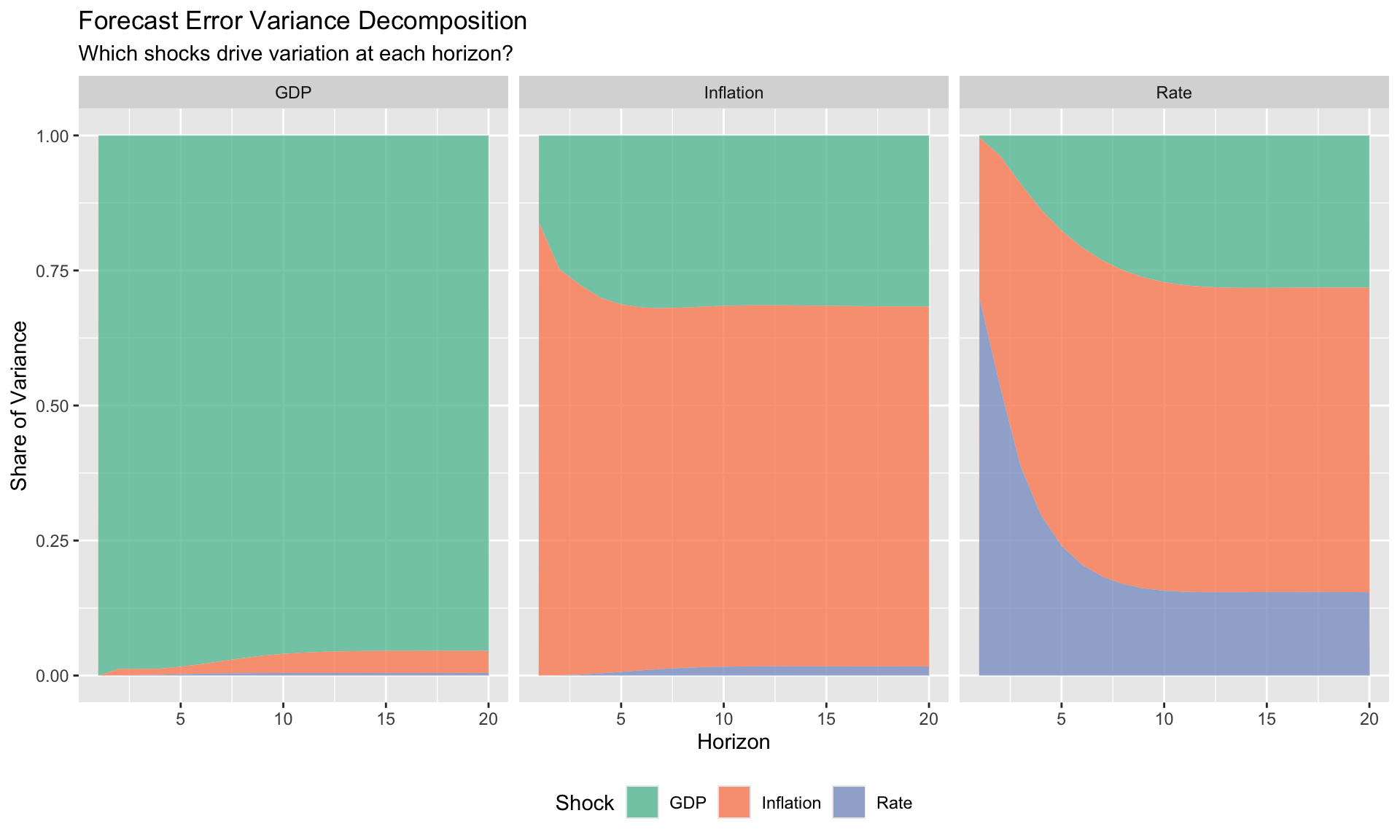
At horizon \(h\), what fraction of the forecast error variance of variable \(i\) is attributable to structural shock \(j\)?

\[ \text{FEVD}_{i,j}(h) = \frac{\sum_{s=0}^{h} (\mathbf{e}_i' \boldsymbol{\Phi}_s \mathbf{B}_0^{-1} \mathbf{e}_j)^2}{\sum_{s=0}^{h} \mathbf{e}_i' \boldsymbol{\Phi}_s \boldsymbol{\Sigma}_u \boldsymbol{\Phi}_s' \mathbf{e}_i} \]

Implementation
Code
# FEVD from vars package
fevd_result <- fevd(var_model, n.ahead = 20)

# Plot
fevd_df <- lapply(names(fevd_result), function(var) {
  df <- as.data.frame(fevd_result[[var]])
  df$horizon <- 1:nrow(df)
  df$response <- var
  df %>%
    pivot_longer(-c(horizon, response), names_to = "shock", values_to = "share")
}) %>% bind_rows()

ggplot(fevd_df, aes(x = horizon, y = share, fill = shock)) +
  geom_area(alpha = 0.8) +
  facet_wrap(~response) +
  scale_fill_brewer(palette = "Set2") +
  labs(title = "Forecast Error Variance Decomposition",
       subtitle = "Which shocks drive variation at each horizon?",
       x = "Horizon", y = "Share of Variance",
       fill = "Shock") +
  theme(legend.position = "bottom")

Forecast error variance decomposition over horizons

Interpretation

  • At short horizons, own shocks typically dominate
  • As horizons extend, other shocks become relatively more important
  • At long horizons: reveals which shocks drive permanent movements

Historical Decomposition

The Question

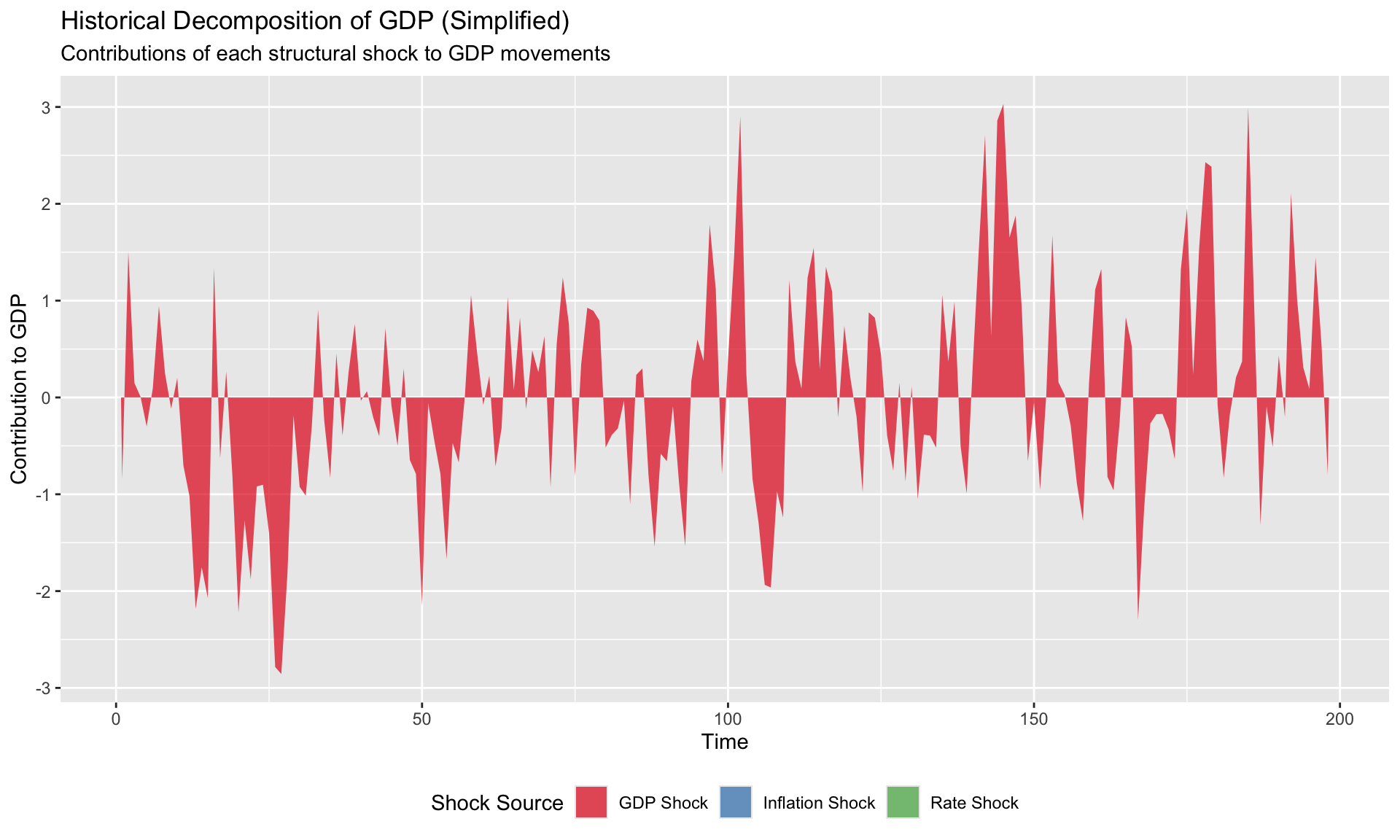
What would the path of variable \(i\) have been if only shock \(j\) had occurred?

\[ y_{it} = \text{deterministic} + \sum_{j=1}^{K} \underbrace{\sum_{s=0}^{t} \Phi_{ij,s} \cdot \varepsilon_{j,t-s}}_{\text{contribution of shock } j} \]
Code
# Simplified historical decomposition illustration
# Shows the concept without expensive recursive computation

# Get structural shocks (Cholesky-identified)
B0_inv_est <- t(chol(cov(residuals(var_model))))
U <- residuals(var_model)
eps <- solve(B0_inv_est) %*% t(U)  # structural shocks (K x T)

# For illustration, show cumulative contributions over a window
T_eff <- ncol(eps)
K <- 3

# Simple approximation: use VAR coefficients at lag 1 only
A1 <- Acoef(var_model)[[1]]

# Contribution of each shock to GDP (variable 1)
# At each time t, contribution ≈ impact + A1 * previous contributions
hd_simple <- matrix(0, T_eff, K)

for (t in 1:T_eff) {
  # Impact effect: row 1 of B0_inv times structural shocks at time t
  hd_simple[t, ] <- B0_inv_est[1, ] * eps[, t]

  # Add propagation from recent shocks (simplified)
  if (t > 1) {
    hd_simple[t, ] <- hd_simple[t, ] + 0.5 * hd_simple[t-1, ]
  }
}

# Plot
hd_gdp <- data.frame(
  time = 1:T_eff,
  `GDP Shock` = hd_simple[, 1],
  `Inflation Shock` = hd_simple[, 2],
  `Rate Shock` = hd_simple[, 3],
  check.names = FALSE
) %>%
  pivot_longer(-time, names_to = "shock", values_to = "contribution")

ggplot(hd_gdp, aes(x = time, y = contribution, fill = shock)) +
  geom_area(alpha = 0.7) +
  scale_fill_brewer(palette = "Set1") +
  labs(title = "Historical Decomposition of GDP (Simplified)",
       subtitle = "Contributions of each structural shock to GDP movements",
       x = "Time", y = "Contribution to GDP",
       fill = "Shock Source") +
  theme(legend.position = "bottom")

Historical decomposition: contributions of each shock to GDP
NoteFull Historical Decomposition

The vars package provides complete historical decomposition via historical_decomposition(). The simplified version above illustrates the concept.

Model Selection and Diagnostics

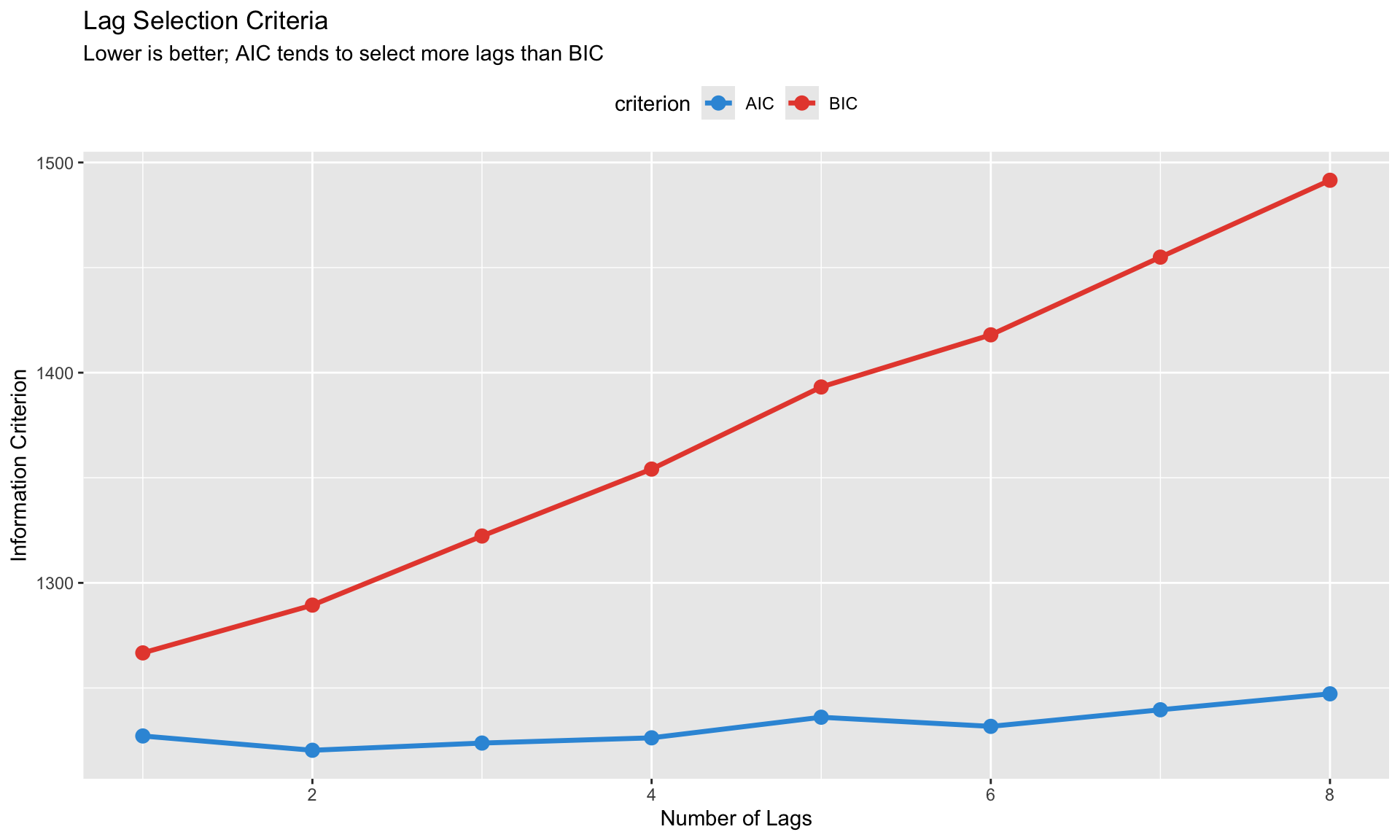
Lag Length Selection
Code
# Already computed above, let's visualize
lag_criteria <- data.frame(
  lags = 1:8,
  AIC = sapply(1:8, function(p) AIC(VAR(Y_ts, p = p, type = "const"))),
  BIC = sapply(1:8, function(p) BIC(VAR(Y_ts, p = p, type = "const")))
)

lag_criteria_long <- lag_criteria %>%
  pivot_longer(-lags, names_to = "criterion", values_to = "value")

ggplot(lag_criteria_long, aes(x = lags, y = value, color = criterion)) +
  geom_line(size = 1.2) +
  geom_point(size = 3) +
  scale_color_manual(values = c("AIC" = "#3498db", "BIC" = "#e74c3c")) +
  labs(title = "Lag Selection Criteria",
       subtitle = "Lower is better; AIC tends to select more lags than BIC",
       x = "Number of Lags", y = "Information Criterion") +
  theme(legend.position = "top")

Information criteria for lag selection

Residual Diagnostics

Code
# Portmanteau test for serial correlation
serial_test <- serial.test(var_model, lags.pt = 12, type = "PT.asymptotic")
cat("Portmanteau Test for Serial Correlation:\n")
Portmanteau Test for Serial Correlation:
Code
cat("Test statistic:", round(serial_test$serial$statistic, 2), "\n")
Test statistic: 72.25 
Code
cat("p-value:", round(serial_test$serial$p.value, 4), "\n")
p-value: 0.9148 
Code
cat("Interpretation:", ifelse(serial_test$serial$p.value > 0.05,
    "No significant serial correlation (good)",
    "Serial correlation detected (consider more lags)"), "\n")
Interpretation: No significant serial correlation (good) 

Summary Checklist

Before trusting your VAR results:

  1. Stability: All eigenvalues inside unit circle?
  2. Lag length: Information criteria checked? Residual autocorrelation tests passed?
  3. Identification: Assumptions documented? Robustness to alternatives checked?
  4. Sample size: Enough observations relative to parameters?
  5. Structural breaks: Any reason to believe relationships changed?

LP vs. VAR: When to Use Which

Equivalence Result

Theorem (Plagborg-Møller & Wolf, 2021): Under correct specification, LP and VAR estimate the same population IRFs.

Practical Differences

Aspect VAR LP
Specification Full system Horizon-by-horizon
Efficiency More efficient if correct Less efficient
Robustness Sensitive to misspecification Robust
Nonlinearity Difficult (threshold VAR) Easy (interactions)
Confidence intervals Tighter Wider (but honest)
Output IRFs, FEVD, historical decomp IRFs only

Recommendations

Use VAR when: - You want FEVD or historical decomposition - System is well-specified and identified - Short horizons with good theoretical grounding

Use LP when: - Single shock identification only - State-dependence or nonlinearity matters - Robustness to misspecification is priority - Panel data

Summary

Key takeaways from this module:

  1. VARs model joint dynamics without imposing much structure—but this flexibility comes with an identification cost

  2. The identification problem: Reduced-form tells us correlations; we need assumptions for causation

  3. Cholesky identification is simple but ordering-sensitive—always check robustness

  4. Sign restrictions are more robust but set-identified—report the range of admissible models

  5. External instruments can achieve point identification with plausible exogeneity—report the F-statistic

  6. FEVD and historical decomposition require structural identification—interpret with caution

  7. LP and VAR are complements: Use LP for robustness, VAR for richer output


Next: Module 5: Staggered Difference-in-Differences